
A word from the Ombudsman
Welcome to the 9th edition of our newsletter, and happy New Year!
2026 is a special year for the office, marking the 20th anniversary of the Public Services Ombudsman for Wales. It’s a milestone that gives us the chance to reflect on two decades of supporting fairness, learning from complaints, and promoting trust in public services across Wales.
We ended 2025 with a busy period of public interest reports, particularly focusing on housing and healthcare issues, including four reports on social housing matters. In November, we launched a consultation into a proposed own initiative investigation on social housing disrepair, damp, and mould, which closed at the start of December.
We also saw the publication of key Senedd reports on our work – our annual scrutiny report and the review of the Public Services Ombudsman (Wales) Act 2019 – and we will highlight the main points from these in this edition.
As always, we will provide updates on Code of Conduct referrals, our complaints standards work, and our outreach activities. We hope this edition gives you a clear picture of the impact of our work and the progress we are making to improve public services across Wales. Here’s to 2026!
From April 2025 to the end of December, we have received 7,989 new cases – of which, 3,191 became duly made complaints.
Compared to this time last year, we are seeing increases in both complaints about public services and about the Code of Conduct. So far we have had 21% more complaints about public services and 1% more complaints about the Code of Conduct.
We also closed 7,782 cases – of which, 3,028 complaints. Public services complaints closures are up by 11%, and Code of Conduct complaint closures are up by 22%.
To see summaries of complaints we resolved early or investigated, see Our Findings.
The Senedd’s annual scrutiny of our Annual Report and Accounts highlights a year of strong performance against a backdrop of sustained and growing demand. Despite a significant increase in caseload since 2019, we closed more complaints than ever before in 2024-25 and reduced the average time taken to complete investigations, while exceeding service quality targets.
The report also notes changing patterns in how people raise complaints, including an increase in submissions in what appear to be generated using artificial intelligence tools. Alongside this, improved signposting and early resolution work is helping to ensure complainants receive appropriate advice before making their complaint to us so that they reach the right public body at the right time. The Committee recognises evidence that our preventative and systemic powers are having a tangible impact, slowing the growth in complaints and contributing to improved complaint handling across public services.
While welcoming this progress, the Committee emphasises the importance of sustainable resourcing, staff wellbeing and expanding proactive improvement work, including own initiative investigations. Overall, the scrutiny reflects confidence in the Ombudsman’s direction of travel and underlines the value of a preventative, system-focused approach to administrative justice in Wales.
You can find the full report by the Committee here.
The Senedd’s Finance Committee has now concluded its post‑legislative review of the Public Services Ombudsman (Wales) Act 2019, finding that the legislation remains fit for purpose and is seen as a model of good practice internationally.
The Act, which was introduced in 2019, significantly strengthened the Ombudsman’s role by introducing new powers, including the ability to accept complaints other than in writing, launch investigations on own initiative, set complaints standards across the Welsh public sector, and consider certain complaints relating to privately funded healthcare.
The Committee recognised that these powers have enabled the Ombudsman to take a more proactive, accessible and inclusive approach, and that they have been widely welcomed by service users, public bodies and third‑sector organisations.
While endorsing the overall effectiveness of the framework, the Committee identified areas where further development would help ensure the legislation continues to deliver for the people of Wales. These include improving awareness and access to the service, refining own‑initiative investigation processes, continuing good practice in complaints handling through continued standards development, and exploring – together with the Welsh Government – the implications of extending the Ombudsman’s remit to school complaints.
In her response, the Ombudsman welcomed the Committee’s recommendations and confirmed that they will inform future priorities, including the development of our office’s Strategic Plan for 2026–29.
Between October and December, we published 7 public interest reports.
Case reference 202401728 – Hywel Dda University Health Board
Ms A, on behalf of 7 complainants, complained that Hywel Dda University Health Board had stopped providing an appropriate specialist service to epilepsy patients who had a learning disability.
We found that when the Health Board’s Learning Disability Epilepsy Service ceased in June 2021, the Health Board did not review the patients on its lists in a timely manner, nor did it provide adequate alternative provision to meet their needs. We also found that, 4 years later, there was still no appropriate and accessible pathway in place to ensure that the needs of this group of patients was adequately met.
We recommended that the Health Board issue apologies to the complainants and take immediate steps to progress its plans to implement a clear and accessible Learning Disability Epilepsy care pathway, ensuring all patients can access care suited to their needs. We also recommended that the Health Board set clear timescales for all action plans, provide detailed updates to each of the seven complainants, and review all Learning Disability epilepsy patient lists.
Full report findings here.
Case reference 202404828 – Cardiff Council
Ms C complained about the condition of the property she rented from Cardiff Council.
Our investigation identified serious service failures which had a devastating impact on Ms C and her family. The Council missed numerous opportunities over nearly 4 years to properly investigate and resolve the causes of the leak and the damp and mould. By March 2024 the property had fallen into an appalling state of disrepair. There were extensive patches of black mould throughout the property and large amounts of water were leaking through a gaping hole in the kitchen ceiling and cascading over live electrical fittings onto surfaces and units.
We recommended that Cardiff Council apologise to Ms C and provide her with £3,000 in financial redress. The Council should also remind staff in the Responsive Repairs Unit to treat all tenants with respect and compassion, particularly regarding complex repairs and issues with damp and mould.
The Council was also asked to provide evidence of review outcomes and action plans, including responses to the thematic disrepair and damp report, and to identify any other tenants affected by systemic issues and provide redress where needed. Finally, the Council should carry out an equality impact assessment of its repair and damp and mould policies.
Full report findings here.
Case reference 202401983 – Flintshire County Council
Miss Y complained about the way her landlord, Flintshire County Council, had responded to reports of damp and mould in her home and whether it had taken appropriate action to provide alternative accommodation.
Our investigation found that the Council failed to identify that Miss Y had made numerous repair requests regarding the same issue. Repair requests were treated in isolation. Officers visited Miss Y’s home on numerous occasions to address new issues, whilst previous repair requests remained outstanding. As such there were many missed opportunities to identify damp and mould and carry out work to address this.
We recommended that the Council apologise to Miss Y and provide financial redress. The Council should also ensure Housing and Communities officers complete paperwork accurately and contact Miss Y to confirm any outstanding work, including a clear completion schedule. Additionally, the Council should develop processes to identify, record, and escalate repeated repair requests.
Further recommendations focused on improving internal procedures. These included creating guidance for assigning Tenant Liaison Officers, developing a more specific decant policy, and reviewing procedures for conducting and recording pre-letting inspections.
Full report findings here.
Case reference 202402960 – Trivallis
Mr B complained about the way the housing association Trivallis dealt with reports of repairs at his home. We investigated whether the Association responded appropriately to reports of damp and mould and a broken boiler.
Our investigation found that the Association did not respond appropriately to reports of damp and mould in Mr B’s home. When Mr B reported issues to the Association, they were not dealt with in line with relevant policies and guidance. As a result Mr B lived in a home with outstanding repairs for nearly 7 years.
Full report findings here.
Case reference 202405250 – Trivallis
Mrs C complained about whether Trivallis responded appropriately to reports of damp and mould made by her between November 2023 and the present time.
Our investigation found that the Association did not always respond appropriately to reports of damp and mould. Reports of issues in Mrs C’s home were not always acted on promptly or line with relevant policies. We also found that the Association’s communication with her was not always appropriate and that the needs of her disabled granddaughters were not clearly considered.
For this case and case 202402960 above, we made a number of similar recommendations. The Association was asked to apologise to the complainants and provide financial redress, and to ensure all relevant staff receive training to identify and respond appropriately to vulnerable customers, including scenario-based training to apply lessons from these cases.
We also recommended developing and implementing a clear damp and mould procedure, including inspecting and addressing any damp in Mrs C’s property, and establishing processes to identify, record, and escalate repeated repair requests, as well as analysing information from property sensors on damp and mould. In addition, the Association was advised to review their records management processes to ensure compliance with our “Good Records Management Matters” principles, and to share these reports with the Association’s Assurance Committee.
Full report findings here.
Case reference 202400797 – Cwm Taf Morgannwg University Health Board
Ms A complained about the Health Board’s delay in hip surgery for her father, Mr B. The investigation considered whether Mr B’s hip surgery had been delayed due to administrative, rather than clinical, reasons.
We found that, without his knowledge, Mr B had been removed from the orthopaedic surgery waiting list. The reason for this was not clear from the Health Board’s records. We were concerned that Mr B had not been notified about his removal from the list (as required by national guidance), and that the Health Board had failed to rectify the situation for well over a year despite complaints being made to it.
We made a number of recommendations to the Health Board. These included apologising to Ms A and Mr B, providing financial redress to Mr B, and providing evidence that it has audited its surgery waiting lists and transferred patient lists to ensure no other patients were similarly overlooked or wrongly removed. We also asked the Health Board to share the report with its Board.
Full report findings here.
Case reference 202407678 – Swansea Bay University Health Board
Mr W complained about a delay in receiving a total knee replacement surgery from Swansea Bay University Health Board, which he had been waiting for since August 2019.
We found that Mr W’s waiting time clock was inappropriately re-set in October 2023. The decision to re-set the waiting time clock was also not communicated to Mr W and he only became aware when he made a complaint. As a result of the delay, Mr W had experienced pain, reduced mobility and ongoing frustration. Further to this, as a result of the delay, he was unable to proceed with surgery, meaning the opportunity for treatment was lost.
Our recommendations to the Health Board included apologising to Mr W and sharing the report with staff. We also asked the Health Board to appoint an independent person to re-audit the orthopaedic waiting list, provide staff training to ensure RTT guidance is correctly applied, and share the report with the Board.
Full report findings here.
In November, we launched a consultation on our next own initiative investigation topic.
The evidence we have seen in our recent casework suggests that social housing tenants in Wales, particularly those that could be considered vulnerable, face issues in how social housing providers respond to report and complaints relating to disrepair, damp and mould. During 2024 -2025, we intervened early in 79 cases relating to these issues. In recent years, we have seen a rise in complaints about social housing in general, with just over 19% of new complaints in 2024-2025 relating to these problems.
We are considering whether it may be appropriate to undertake an own initiative investigation/s into this area. Own initiative investigations allow us to look into matters even without receiving a complaint, where there are concerns that public services may have fallen short, the issue could have a negative impact on a wide group of citizens (particularly if they may be vulnerable or disadvantaged); and it would be in the public interest to investigate.
We received 37 responses to our consultation including from social housing tenants, social housing providers, Welsh Government, third sector advice, advocacy and support organisations, and other interested parties. The vast majority of the responses we received agreed that it would be in the public interest to investigate this issue, highlighting the opportunity for further learning and improvement.
Some respondents questioned whether it was the right time for such an investigation, particularly with planned changes to the Welsh Housing Quality Standard, impacting how social housing providers respond to hazards including damp and mould, which comes into force on 1 April 2026. However, other respondents did not see this as a barrier to an investigation, instead referring to it as complementing these changes and aiding their implementation. Full analysis of all the responses received is currently being undertaken. A decision will be made early in 2026 on whether to proceed with a formal investigation proposal to investigate a body or bodies.
Keep an eye on our website for any future updates regarding this proposed investigation.
We continue to focus on reducing the time our investigations take to complete. So far this year, we have closed 65 investigations, significantly more than we have over the last couple of years, and 5 have resulted in a referral to either a standards committee or the Adjudication Panel for Wales.
Two hearings have been held since the end of September, which you can see the summary of below:
Case reference 202108695
We received a complaint that a Former Member of Chirk Town Council had breached the Code of Conduct.
It was alleged that the Former Member acted without authority and inappropriately in relation to 2 separate grant applications on behalf of the Council, which contained false and misleading information.
Our investigation found that the Former Member’s conduct was suggestive of a breach of paragraph 6(1)(a) of the Code of Conduct. The report on the investigation was referred to Wrexham County Borough Council’s Standards Committee, which found that the Former Member had failed to comply with the Code and decided that the appropriate sanction was a censure.
This decision is subject to appeal.
Case reference 202309568
We received a complaint that a Member of Cyngor Gwynedd had breached the Code of Conduct.
It was alleged that the Member had received a Conditional Caution for “Fraud by abuse of position” by attempting to defraud his employer, through the misappropriation of funds.
Our investigation found that the Member’s conditional caution and misconduct could reasonably be regarded as having brought his office as member and his County Council into disrepute and was, therefore, suggestive of a breach of paragraph 6(1)(a) of the Code of Conduct. The report on the investigation was referred to the Adjudication Panel for Wales, for adjudication by a tribunal. The tribunal found that the Member had failed to comply with the Code and decided that the appropriate sanction was for the Member to be disqualified from acting as a member for any relevant authority for a period of 3 years.
This decision is subject to appeal.
Our CSA team have been continuing their work with housing associations to formally bring them under the Complaints Standards Authority. We have 21 Housing Associations now operating under the Standards and a further 5 associations who have now all started their 6 month period to review their policies, ensure their data collection is appropriate and receive training.
We are also engaging with the remaining 6 associations, meaning all will start the process before the end of the financial year.
We would like to thank all organisations who have worked with us over the past 12 months to achieve this and we look forward to continuing with all those under the Standards, which also includes all local authorities and Health Boards & Trusts, to provide the public with consistent complaint services across Wales.
Legislation requires that all public bodies are brought under the Complaints Standards and work is now starting to plan out how we will roll out Complaints Standards to other public sector bodies during 2026 and beyond.
Our latest Sustainability Report highlights continued progress in reducing the environmental impact of our operations, alongside greater transparency in how we measure and report our performance.
During 2024–25, we reduced electricity usage across our office by 25%, driven by a smaller office footprint and the installation of more energy-efficient air-conditioning systems. This has resulted in a corresponding reduction in carbon emissions.
We also improved our waste performance, recycling 84% of all waste produced during the year, compared with 72% the previous year. All non-recyclable waste was diverted from landfill, and increased recycling largely reflected the responsible disposal of old IT equipment. Continued digitisation of our work is helping to reduce paper use and waste more broadly.
Sustainability remains embedded in our strategic planning and office related decision-making. Hybrid working continues to play a key role in reducing energy use, while improved data collection is strengthening the accuracy of our carbon reporting.
Looking ahead, we remain committed to maintaining reduced energy use and waste, and to encouraging staff to play their part in minimising environmental impact.
Read the report here.
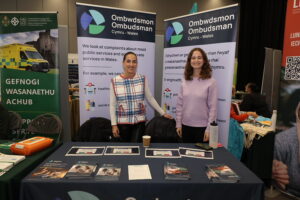
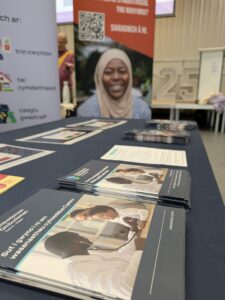
We had a busy period of outreach to end the year! Here are the events we attended to raise awareness of our work and to connect with a range of communities:
Minority Ethnic Communities Health Fair
On 29 October, we attended the Minority Ethnic Communities Health Fair in Cardiff, hosted by the Cardiff Third Sector Council. Our stall provided an excellent opportunity to engage with people from diverse communities who may be less familiar with our service or feel that barriers exist to making a complaint. The event allowed us to raise awareness of how we can support them and to promote confidence in accessing our services.
TPAS Cymru conference
On 12–13 November, we attended the TPAS Cymru Conference in Llandrindod Wells, where our stall was busy and well attended. The Ombudsman hosted a workshop exploring who we are, what we do, and how we support tenants, which sparked lively discussion and generated thoughtful questions and feedback. The event was particularly timely, aligning with our initiative consultation and recent public interest reports, and we look forward to continuing the conversation and to hearing more tenants’ views through our consultation responses.
House of Commons External Services Fair
On 18 November, we attended the House of Commons Administration’s first-ever External Services Fair, alongside a range of Government Departments, Ombudsmen and external organisations. The event provided a valuable opportunity to engage directly with MPs and their offices, raise awareness of our role, and explain how we can support them with constituency casework. We had open and constructive conversations, highlighting our processes and promoting the training sessions we offer to help MPs and their staff better understand how we work.