
A word from the Ombudsman
Welcome to the 11th edition of our newsletter.
Now that the first quarter of this financial year has come to a close, we will give you updates on what we have been up to regarding our recent public interest reports, Code of Conduct referrals and decisions, and our complaints standards work.
More details on our work during 25-26 will follow in our Annual Report, to be shortly laid before the Senedd. However, one of the key trends, ongoing from last year, is that the number of our new complaints continues to rise sharply. Compared to the first quarter of last year, we have already received 48% more complaints about public services and 18% more complaints about the Code of Conduct.
While we continue to explore ways to manage this workload in a timely and efficient manner, we have been developing our engagement with stakeholders who support, advise and represent complainants. Over this last quarter, we sponsored and attended gofod3, attended the Senedd Marketplace and offered more online training on our role and process. It’s been wonderful connecting with so many of you and hearing your thoughts on our work. We hope to engage with many more of you in the coming months!
In this newsletter, we also bring you the high-level results of two recent surveys that help us target our work: national awareness survey and survey of service providers in our jurisdiction.
While our eyes are firmly on the future, we have also continued to mark the 20th anniversary of our office, posting on social media about our history, milestones and impact. We’re pleased to be able to tell our story of where we have come from and where we are heading. While we go into further detail later on in the newsletter, we invite you to enjoy a short video below, highlighting what we are about!
The number of our new complaints about public services continues to rise sharply. Between April and June this year, we have already received 1130 new complaints about public services – a 48% increase compared to the same period last year.
We also already closed 37% more public service complaints than this time last year. So far, we intervened in (proposed Early Resolution or investigated) 141 public service complaints that we closed. We continue to develop closer links with voluntary and advisory organisations to promote our oral complaints service and inform our Own Initiative investigations.
Between May and July, we have published the following public interest report.
Case reference 202501841 – Betsi Cadwaladr University Health Board
The investigation considered whether it was clinically appropriate to prescribe Sevredol (morphine sulphate) to a patient at Wrexham Maelor Hospital in March 2024, and whether the patient and his family were provided with sufficient information and support to minimise the safety risks associated with the prescription. We found that morphine sulphate was issued mistakenly, and that there was a series of failures to carry out expected checks which would have identified this error. We found that the patient was given a controlled medication without being made aware of the risks or given guidance on safe use, including the risk of potentially fatal unintentional overdose. As a result, we concluded that it was not safe to provide the patient with Sevredol in these circumstances. Tragically, the patient died of a morphine overdose 2 days later.
We are also continuing to see an increase in new complaints about the Code of Conduct. Between April and June this year, we have already received 18% more complaints than during the same period last year.
We include the summary of one hearing below:
Case Reference: 202501166
A member of Cardiff Council self-referred a complaint in relation to a potential breach of the Code of Conduct after pleading guilty at Magistrates’ Court to a charge of “locking on”, at a protest, which resulted in him receiving a fine and conditional discharge.
Our investigation found evidence suggesting that the Member’s actions had brought the Council and/or his role of councillor into disrepute.
The case was referred to the Council’s Standards Committee. The Committee decided that the appropriate sanction was to suspend the Member for a period of 2 months.
In our role as Complaints Standards Authority (CSA), we continue to work collaboratively with a range of organisations providing public services across Wales to realise the vision for a consistent complaints handling procedure for all service users.
We have been focusing this year particularly on housing associations, working to bring all of them under Complaints Standards. We now have 27 housing associations operating under these Standards, with the remaining five making strong progress towards compliance. All are on track to achieve this by the end of September.
We remain extremely grateful to all organisations that have worked with us to review and develop their policies and data systems and to support staff through training opportunities. This collective effort has enabled us to successfully onboard a significant number of organisations. We look forward to continuing to work with and support those operating under the Standards, ensuring the public receives consistent complaints services across Wales.
We are also looking ahead to the next phase of rollout, which will extend the Complaints Standards to other key public service sectors, including primary care providers.
Each year, we commission a national survey to track public awareness of the office and how it’s changing over time. Our latest results are in, and there’s plenty of good news to share.
Awareness has risen to 52% this year (up from 48% last year), with improvements across some specific communities as well. We saw an especially strong 10 percentage point increase in awareness among ethnically diverse communities.
Word of mouth continues to be the main way people hear about us (29%), and that figure has grown steadily. Awareness through TV/radio (12%), the press (8%) and internet search (9%) remains broadly consistent with last year.
Public confidence also remains high. 79% of people said they have confidence in us – matching last year’s record level. Most respondents also felt we are impartial (80%) and that they could approach us if needed (87%).
Overall, the results show a positive picture: rising awareness, strong trust, and continued confidence in our integrity. This is a solid platform for our ongoing communications and engagement work in 2026-27!
Every year, we organise a service satisfaction survey of complaints officers at key service providers in our jurisdiction – health boards, local authorities and housing associations. This year, we also organised a similar survey of Chief Executive Officers at these organisations.
This year’s survey results give us a broadly positive picture of how our work is viewed, while also highlighting practical areas where we can improve.
The Chief Executive survey was especially encouraging. Almost all respondents agreed that we are independent and impartial, 82% agreed that we have a positive impact on public services in Wales, and 84% said that complaints standards work has improved their organisation’s reporting on complaints we handle. Nearly three quarters of respondents, 72%, also agreed that our recommendations led to tangible improvements.
The complaints officers that responded to our survey rated our service 8.4 out of 10 overall – a slightly higher result than last year. 85% of the officers agreed that our findings positively influence their organisation, and the respondents rated highly the influence of our public interest reports, thematic reports and own initiative reports.
At the same time, respondents across both surveys identified areas for improvement. These related to:
- updates on open complaints
- deadlines to provide evidence
- timeliness of our work
- guidance from staff
- availability of complaints standards training.
We are taking this feedback seriously. We are responding through work already underway, including progressing a new complaints portal, reviewing how we share updates on Code of Conduct complaints, applying standard timeframes with flexibility where needed, improving how we capture compliance with recommendations, developing a factsheet for complaints officers, and sharing more good practice, learning and sector-specific insights.
We have continued to mark our 20th anniversary in the last few weeks, with more social media content being posted on LinkedIn, Facebook and Instagram. In addition to the video we shared with you at the start of this newsletter, we also posted about our key milestones along the years: how we made it easier for people to be heard from 2006-2012, how we turned complaints into service improvements from 2013-2019, and how we reached more people and drove deeper change
from 2020-2025. This way, we have been able to show the timeline of certain key developments and publications that have taken place since the inception of our office as it is today, and how our role has grown along the way.
We have recently also developed a wealth of video resources presenting a concise overview of different aspects of our role and service.
We hope that these will not only be helpful to complainants, but also to the new Members of the Senedd, constituency teams and advice and advocacy organisations across Wales.
You can find these videos on our website here, or see each individual video below:
#2 What happens when you complain about public services – our process
On 17 June, we attended gofod3, the biggest voluntary sector event of its kind in Wales. As an event sponsor, we were proud to support WCVA in bringing voluntary sector organisations together to share knowledge, strengthen connections and explore ways to create positive change for people and communities across Wales.
It was a fantastic day, with opportunities to connect with a wide range of advice, advocacy and community organisations
and explore opportunities for closer engagement to inform our Own Initiative investigations and to encourage take up of our oral complaints service. Alongside conversations at our exhibition stand, more than 40 people attended our workshop, Building Voluntary Sector Partnerships to Improve Public Services.
We would like to thank everyone who took part in the discussion and shared their insights. These conversations will help inform our future engagement with the third sector and our ongoing work to improve public services.
You can read more about our commitment to strengthening relationships with the third sector in our recent blog on the WCVA website, as well as our three key takeaways from the event.
We were delighted to take part in gofod3 and look forward to continuing these valuable conversations.
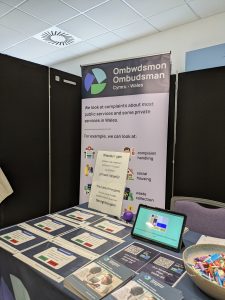
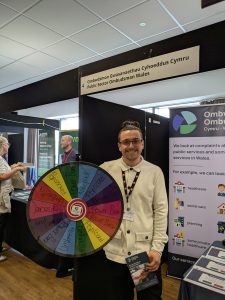
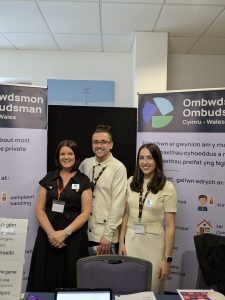
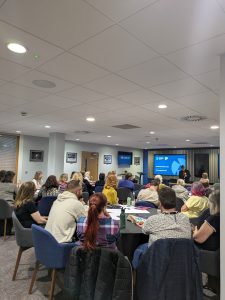
We know that assisting constituents who experience difficulties with public services is an important part of the Members’ role and we are keen to ensure that they have at their fingertips up-to-date and accessible information about when and how the Ombudsman can help.
We started the ball rolling on 2 June by attending the Marketplace – a networking event where organisation can host stands in the Senedd to raise awareness of their work.
We also contacted all new Members with a welcome message from Michelle, encouraging them to consider our service when they support their constituents and presenting the available resources about our role and process.
We have further events planned for the autumn, to continue to engage with the Members and highlight how we can support them in their vital work.
On 6 May, we held a training session with Crisis Cymru which gave an overview of our role, process, and how we investigate complaints. As we have undertaken a lot of housing casework over the past several months, this was a great opportunity to highlight what we have done in this area and how we can help with future housing complaints.
This free, online training is available to any organisation that wants to know more about us and what complaints we can look at, so if your organisation is interested, please contact communications@ombudsman.wales to arrange a session.
Finally, we are pleased to launch today a public consultation on our Equality Plan 2026-29.
Our work is about people — especially those who may face barriers when trying to complain, be heard or access support. This Plan sets out how we will continue to make our service more accessible, inclusive and impactful for different communities across Wales. We identify 5 proposed Equality Objectives and we welcome your views! The consultation will close on 24 September.